
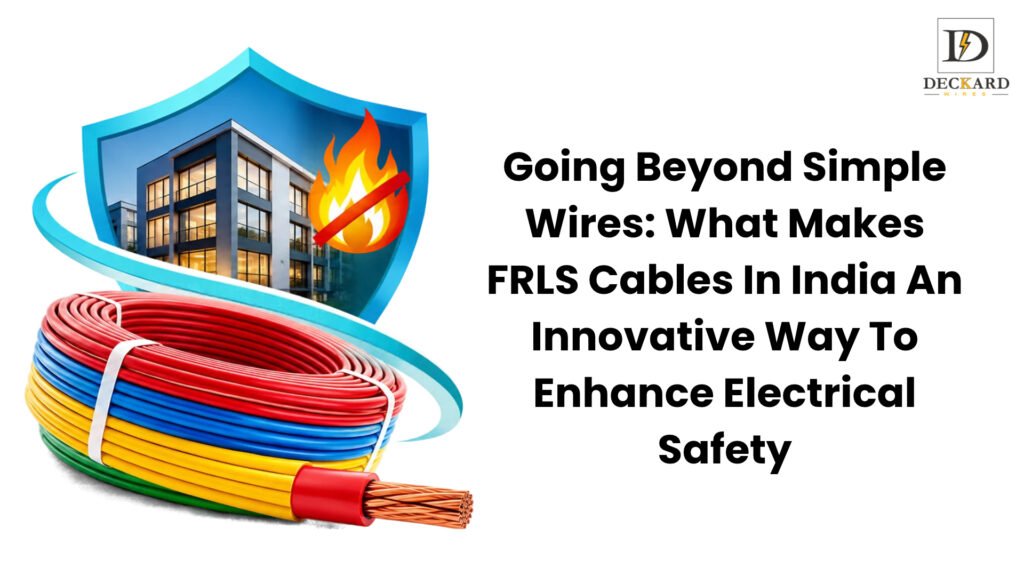
Electrical safety is not achieved once the switch is turned on. Electrical wires installed behind walls, ceilings, and electrical panels ensure electricity distribution throughout the building. The selection of an electrical cable is based not only on its cost. Other criteria like conductor material, wire size, voltage rating, and insulation properties are equally important.
FRLS cables in India have become increasingly popular due to their flame-retardant properties along with low smoke emission. Both features can become valuable assets in a building where fire safety and safe evacuation play a vital role. Detailed knowledge about FRLS technology and the difference between conventional electrical wire categories will enable consumers to make informed choices.
What Is So Special About FRLS Cables In India As Compared With Ordinary Electrical Wires?
FRLS stands for Flame Retardant Low Smoke. Such cables are produced with insulation specially developed to resist fire propagation along the cable and minimize smoke emissions during a fire.
Two of its most prominent features perform different functions:
- Flame retardance: Limits the spread of flames along the cable.
- Low smoke emission: Minimizes the amount of smoke produced during a fire.
When a fire erupts in a building, smoke can spread through corridors, staircases, and other public spaces and obstruct escape routes. FRLS cables are designed to address both fire propagation and smoke emission concerns.
However, FRLS cables are not fireproof. Their performance greatly depends on the construction, insulation materials, and relevant testing requirements.
Why Is Smoke Emission Reduction So Important For Safety Of Building Occupants?
Smoke can become a serious problem in case of a building fire. It reduces visibility, interferes with evacuation, and may contain harmful gases depending on the materials involved.
In commercial buildings, hospitals, schools, shopping centres, and residential towers, many people may need to evacuate using the same escape routes. Reduced smoke emission can help maintain better visibility compared with cables that do not have low-smoke characteristics.
It is important to note that low smoke emission does not mean that the cable produces no smoke or no toxic fumes. Before making any choice, it is necessary to review the specifications and test documentation of the cable.
FR vs FRLS vs FRZH: Key Differences Between These Cables
Electrical wires come in a variety of insulation technologies. FR, FRLS, and FRZH are some such types that do not mean the same thing.
FR Cables – Flame Retardant
FR is an abbreviation for Flame Retardant Cables. These cables are made using insulation technology that resists flames from spreading through the cable during specified tests.
FRLS Cables – Flame Retardant Low Smoke
FRLS cables are similar to FR cables but provide the additional advantage of reducing smoke emissions. This means that they offer both flame-retardant and low-smoke characteristics.
FRZH Cables – Flame Retardant Zero Halogen
FRZH cables, on the other hand, use insulation technology designed to be free from halogens. This makes them different from cables that are simply classified as low-smoke cables.
| Cable Type | Full Form | Key Characteristic |
|---|---|---|
| FR | Flame Retardant | Resists flame propagation |
| FRLS | Flame Retardant Low Smoke | Flame retardance and reduced smoke emission |
| FRZH | Flame Retardant Zero Halogen | Flame-retardant and halogen-free insulation characteristics |
In Which Buildings Can You Consider Using FRLS Electrical Wires?
FRLS electrical wires can be considered in different kinds of buildings depending on the requirement for reduced smoke emission from electrical wires.
- Residential Buildings: FRLS cables may be considered for household electrical wiring when the requirements of the circuits and installations are satisfied.
- Commercial Buildings and Offices: The presence of shared spaces and many occupants makes it important to give fire-performance aspects due consideration.
- Hospitals and Educational Institutions: The choice of cables must depend on the requirements of the electrical design of the building.
- Industrial Facilities: Cable selection must consider the electrical load, operating conditions, and installation environment.
It is the electrical design and requirements that matter when selecting the right cable for a project, not just the type of building.
How To Select The Right FRLS Cable?
There are various things to consider when selecting the right FRLS cable.
Check Conductor Material
The conductor is responsible for carrying electricity through the cable. Find out what material has been used in the cable and its conductor structure. Copper conductor options are available in the Deckard Wires product range.
Wire Size and Electrical Load
The size of the cable is usually expressed in sq. mm. The right size depends on the load, length, installation methods, and the temperature around the cable.
An incorrectly sized cable may overheat when operated beyond its capacity. Consult an electrician or an electrical engineer to determine the correct cable size.
BIS Standards & Test Documentation
Check manufacturer information, product markings, cable type, and conductor size, along with relevant Indian standards. Ask for test documentation when required.
Consider The Installation Location
The installation environment can be indoor, outdoor, industrial, or concealed. Temperature, moisture levels, and mechanical factors should be considered before choosing a cable.
Conclusion
Safety begins with the proper choice of cable. Understanding flame retardance, smoke characteristics, conductor size, voltage rating, and insulation material will help consumers select appropriate electrical wiring.
FRLS cable in India provides both flame-retardant and reduced-smoke qualities. Still, the correct choice will depend on the electrical design and installation location.
For your residence or industry, consult an experienced electrical engineer. Explore the product range of electrical wiring from Deckard Wires to learn more about suitable wiring solutions.