Uncategorized

electric wire in india
Uncategorized

Safety Standards for Electrical Cables in India

At Deckard Wire, we understand that safety is non-negotiable when it comes to wiring and electrical installations. Every structure — residential, commercial or industrial — depends on reliable cables that meet the the highest safety benchmarks. That is why following the electrical cables safety standards in India is critical for performance, compliance, and peace of mind. Why safety standards matter Using substandard or uncertified cables can lead to serious hazards — short circuits, overheating, insulation breakdown, or even fire risks. Adhering to recognized standards helps ensure cables are designed, manufactured, and installed in a way that protects lives and assets, ensures longevity, and reduces maintenance costs. Good compliance also helps installers, engineers, and property owners avoid regulatory fines or project delays. Key Indian regulatory & standard frameworks Some of the primary standards and regulatory frameworks for electrical cables in India: • The Bureau of Indian Standards (BIS) sets technical norms for cable construction, insulation, conductor materials, current carrying capacity, and testing. • Many cables fall under mandatory certification orders; BIS issues mandatory product orders specifying which electrical wires, cables, accessories must comply with Indian standards. • For conductors (copper or aluminium) in insulated cables, standards like IS 8130 define classes of conductors (fixed installations vs flexible cords) and maximum resistance or flexibility requirements. • For heavy duty electric cables (PVC insulated, armoured/unarmoured), relevant standard IS 1554 (Part 2) mandates design, construction and testing criteria for working voltages up to certain high-voltage levels. What the standards specify Here are some of the typical requirements that these standards enforce: Parameter Typical requirements under Indian standards Conductor material Cables use copper or aluminium conductors with well defined cross-sections and classes (for fixed or flexible use). Insulation & sheathing For PVC insulated cables, there are specifications for insulation thickness, mechanical strength, resistance to heat, moisture, chemicals. Current rating Standards like IS 3961 (various parts) provide recommended current ratings depending on installation method (clipped, bunched, enclosed or exposed). Certification & marking Mandatory certification ensures product compliance; certified cables carry proper IS reference, licence number, marking to show conformity. Installation rules Rules require proper spacing, ambient temperature derating, grouping factors etc for safe current carrying capacity. Deckard Wire’s commitment to compliance As a manufacturer / supplier, Deckard Wire is committed to upholding all relevant electrical cables safety standards. Here’s how we ensure quality: • We use certified conductors (copper/aluminium) conforming to required classes for both fixed and flexible applications. • Our cables are insulated and sheathed using materials tested to meet or exceed Indian standard requirements (insulation thickness, mechanical durability, environmental resistance). • All our products undergo rigorous testing for current carrying capacity under various installation conditions (enclosed, bunched, or exposed routing) to validate derating factors. • We maintain full compliance with mandatory BIS orders, ensuring that cables are properly marked, labelled and certified for sale and installation. • We also provide detailed technical documentation and guidance for installers to ensure safe installation (spacing, ambient temperature corrections, grouping derating). Deckard Wire’s commitment to complianc As a manufacturer / supplier, Deckard Wire is committed to upholding all relevant electrical cables safety standards. Here’s how we ensure quality: • We use certified conductors (copper/aluminium) conforming to required classes for both fixed and flexible applications. • Our cables are insulated and sheathed using materials tested to meet or exceed Indian standard requirements (insulation thickness, mechanical durability, environmental resistance). • All our products undergo rigorous testing for current carrying capacity under various installation conditions (enclosed, bunched, or exposed routing) to validate derating factors. • We maintain full compliance with mandatory BIS orders, ensuring that cables are properly marked, labelled and certified for sale and installation. • We also provide detailed technical documentation and guidance for installers to ensure safe installation (spacing, ambient temperature corrections, grouping derating). Best practices for installers & users To maximize safety and performance when using cables from Deckard Wire or other trusted brands: • Verify certification: always look for the IS standard number (e.g. IS 1554, IS 8130 etc) and the BIS licence marking. • Choose right cable for application: depending on installation (fixed vs flexible, ambient temperature, exposed or in duct). • Apply derating factors: when cables are grouped or in high temperature, follow standard-prescribed corrections. • Follow installation guidelines: maintain spacing, avoid sharp bends, ensure proper earthing. • Periodic inspection: check insulation integrity, look out for damage or aging. Why it matters for your project Using cables that meet the electrical cables safety standards in India ensures: • Safe and reliable power distribution • Longevity of cable installations • Compliance with regulations and avoids legal or safety issues • Peace of mind for property owners, engineers, contractors Conclusion Safety standards are not just guidelines — they are the backbone of reliable electrical installations. At Deckard Wire, we pledge to deliver cables engineered to meet or exceed the standards, so your wiring projects remain safe, efficient and long-lasting. When you choose Deckard Wire, you choose quality, compliance, and trust in every meter of cable.

electric wiring cables in india
Uncategorized

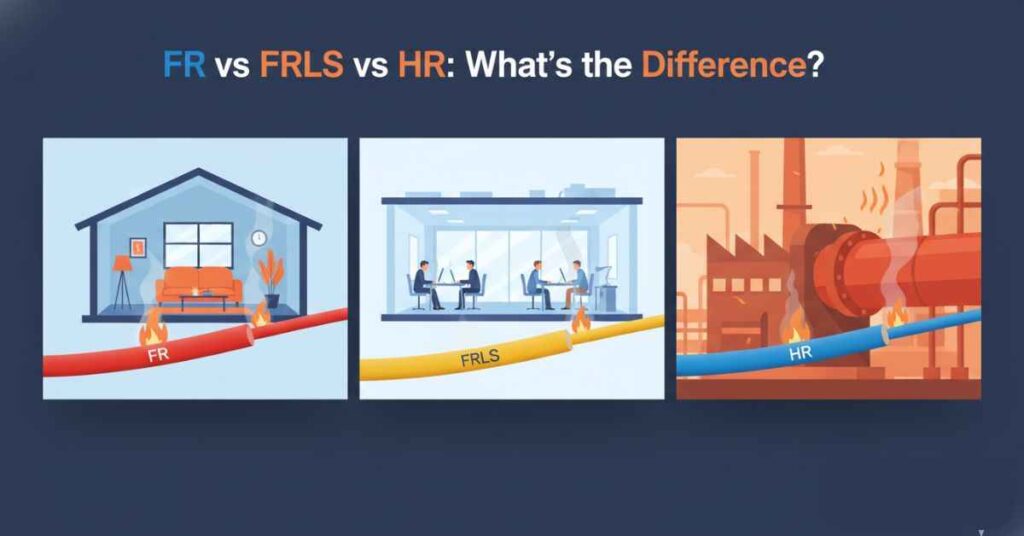
FR vs FRLS vs HR: What’s the Difference?

When it comes to choosing the right electrical wires for your home, office, or industrial setup, safety should always come first. The type of insulation around a wire can make all the difference between a safe electrical system and a potential hazard. You may have come across terms like FR, FRLS, and HR wires — but what exactly do they mean, and how do they differ from one another? In this guide, we’ll break down the key differences between Flame Retardant (FR), Flame Retardant Low Smoke (FRLS), and Heat Resistant (HR) wires, helping you make the right choice for your needs. 1. Understanding FR Wires (Flame Retardant Wires) FR wires, or Flame Retardant wires, are designed to resist the spread of fire when exposed to high temperatures. While they don’t completely stop burning, they slow down the flame’s progress, giving you more time to act in case of a fire. Key Features of FR Wires • Flame Retardant PVC Insulation: The insulation is made using a special PVC compound that prevents fire from spreading quickly • Thermal Stability: These wires can withstand temperatures up to 70°C. • Safety Level: Offers basic fire protection — ideal for low-risk environments. • Durability: Resistant to moisture, oil, and chemicals, ensuring longer life. Applications FR wires are commonly used in: • Residential buildings • Offices and small commercial spaces • Electrical panels and light circuits Pros ✅ Cost-effective ✅ Adequate for everyday domestic use ✅ Good insulation and flexibility Cons ❌ Emits dense smoke and toxic gases when burned ❌ Not ideal for crowded or closed environments 2. Understanding FRLS Wires (Flame Retardant Low Smoke Wires) FRLS wires are an upgraded version of FR wires, offering enhanced safety in case of fire. They are made from a special PVC compound that not only resists flames but also emits low smoke and low toxic gases, making them safer in emergencies. Key Features of FRLS Wires • Low Smoke Emission: In case of a fire, visibility remains higher, helping people escape safely. • Low Toxicity: The insulation emits less halogen gas, reducing harm to humans and equipment. • Flame Retardant Property: Prevents fire from spreading quickly. • Temperature Resistance: Can typically withstand up to 85°C. Applications FRLS wires are ideal for: • High-rise buildings • Hospitals and schools • Shopping malls and cinema halls • Industrial areas and data centers Pros ✅ Enhanced fire safety ✅ Reduces smoke and toxic gas emissions ✅ Ideal for public and commercial infrastructure Cons ❌ Slightly costlier than FR wires ❌ May still emit some smoke and gases during combustion 3. Understanding HR Wires (Heat Resistant Wires) As the name suggests, HR wires, or Heat Resistant wires, are designed to perform under high temperatures. These wires are manufactured using heat-resistant PVC compounds or cross-linked polymers that can operate safely even in extreme heat conditions. Key Features of HR Wires • High-Temperature Endurance: Can withstand temperatures up to 105°C or even more. • Strong Insulation: Maintains integrity and performance even after prolonged exposure to heat. • Durability: Resistant to deformation, cracking, and insulation breakdown. • Electrical Stability: Ensures steady current flow and prevents overheating. Applications • HR wires are preferred in: • Industries and factories • Power plants and refineries • Kitchen appliances and heating equipment • Automotive and heavy machinery Pros ✅ High heat resistance ✅ Superior durability and lifespan ✅ Ideal for high-load circuits and hot environments Cons ❌ More expensive than FR and FRLS wires ❌ Over-engineered for basic domestic use 4. Which Wire Should You Choose? The right wire depends on your application, environment, and safety requirements. • For homes and offices, FR wires are sufficient as they balance cost and safety. • For public buildings or high-density areas, FRLS wires are the smarter choice because they ensure safety with minimal smoke and toxicity. • For industrial or high-temperature environments, HR wires offer the durability and resistance needed to handle continuous heat exposure. In short: • Choose FR for standard home use. • Choose FRLS for safety-critical commercial spaces. • Choose HR for heat-intensive industrial setups. 5. Why Choose Deckard Wires? At Deckard Wires, we believe that safety, quality, and durability should never be compromised. Our wires are ISI-marked, made from 100% pure copper conductors, and manufactured with advanced insulation technology to ensure maximum performance and safety. What Makes Deckard Wires Stand Out • ✅ Fire-resistant and long-lasting insulation • ✅ Consistent current carrying capacity • ✅ Environmentally safe and compliant materials • ✅ Rigorous quality testing before dispatch When you choose Deckard Wires, you’re not just choosing a wire — you’re choosing peace of mind, safety, and trusted performance that lasts for years. Conclusion Whether you’re building a new home, renovating an office, or wiring an industrial setup, understanding the difference between FR, FRLS, and HR wires helps you make a safer, smarter choice. Remember: the right wire can prevent disasters, enhance efficiency, and protect what matters most — your family, employees, and property. Deckard Wires is committed to powering India with safe, durable, and reliable wiring solutions — because every connection matters.

electric wire online in india
Uncategorized

How to Choose the Right Wire for Home Wiring

When it comes to building or renovating your home, wiring is one of the most important aspects that determines your safety, convenience, and long-term cost efficiency. Choosing the right wire is not just about connecting electricity — it’s about ensuring your home runs smoothly and safely for years to come. At Deckard Wires, we believe in empowering homeowners with the right knowledge to make smart electrical choices. So, let’s dive into everything you need to know about how to choose the right wire for home wiring. 1. Understand the Basics of Electrical Wires Before choosing, it’s essential to understand what makes up a wire. Every electrical wire has three main parts: • Conductor: The metal that carries current (usually copper or aluminum). • Insulation: A protective layer that prevents electric shocks and short circuits. • Sheath: The outer covering that protects the wire from moisture, heat, and wear. Your goal is to select a wire that provides efficient current flow, has strong insulation, and can withstand environmental conditions over time. 2. Choose the Right Conductor Material The two most common conductors used in home wiring are copper and aluminum. Here’s why most experts — and we at Deckard Wires — recommend 100% pure copper wires: • Better Conductivity: Copper wires offer superior current-carrying capacity. • Durability: Copper is more resistant to corrosion and mechanical wear • Safety: Pure copper reduces the risk of overheating and electrical fires. • Longevity: It ensures a consistent power supply with minimal voltage drop. While aluminum wires are cheaper, they are less durable and prone to oxidation. For home safety and long-term performance, copper wires are the best investment. 3. Check for Fire-Resistant Insulation Safety starts with insulation. When selecting wires for your home, make sure they have Fire-Resistant (FR) or Flame Retardant (FR-LSH) insulation. • FR Wires: These resist the spread of fire and protect against electrical hazards. • FR-LSH Wires: Fire Retardant Low Smoke Halogen wires emit minimal smoke and toxic gases during fire, providing extra safety. At Deckard Wires, our wires come with fire-resistant insulation technology to ensure your home stays safe, even in critical situations. 4. Select the Correct Wire Gauge (Size) The wire size — measured in square millimeters (sq.mm) — affects how much current a wire can safely carry. Using the wrong size can lead to overheating, energy loss, and even fire hazards. Here’s a general guide: Appliance/Use                                                              Recommended Wire Size Lighting circuits                                                           1.0 – 1.5 sq.mm Fans & small appliances                                             2.5 sq.mm Heavy appliances (AC, geyser, oven)                        4.0 – 6.0 sq.mm Main power line                                                             10.0 sq.mm and above It’s always best to consult a certified electrician to determine the right size based on your home’s total load. 5. Go for Branded and Certified Wires Electrical wiring is not the place to compromise on quality. Always choose wires that are ISI-marked and comply with BIS (Bureau of Indian Standards) specifications. Why? Because certified wires go through strict testing for insulation resistance, voltage endurance, and flame resistance. Deckard Wires meets all these standards, ensuring premium quality, safety, and reliability in every meter of wire. 6. Consider the Environment and Application Different areas of your home require different wire types. • Indoor wiring: Use standard copper wires with FR insulation. • Outdoor wiring: Opt for UV-resistant and moisture-proof wires. • Bathroom & kitchen wiring: Choose wires with high heat and water resistance. Deckard Wires offers a variety of specialized wires for every condition — so you can choose exactly what your space needs. 7. Don’t Ignore Flexibility and Ease of Installation A wire’s flexibility matters more than you think. Stiff wires are difficult to install, especially in concealed wiring. Flexible multi-strand wires are easier to bend, pull through conduits, and connect. Deckard’s flexible wires are designed for hassle-free installation while maintaining excellent electrical conductivity and safety. 8. Energy Efficiency and Long-Term Value Good quality wires reduce power loss due to resistance, leading to lower electricity bills and less maintenance. Cheap, substandard wires may save you money initially but can result in frequent faults, overheating, and higher long-term costs. By choosing Deckard Wires, you invest in energy-efficient wiring that performs reliably for decades. 9. Seek Expert Advice If you’re unsure about what wire type or size to choose, it’s always smart to consult professionals. Deckard Wires works closely with expert electricians and distributors who can guide you to the best product for your requirements. Conclusion Your home deserves wiring that is as dependable as it is safe. From pure copper conductors to fire-resistant insulation, every detail matters when it comes to choosing the right wire. With Deckard Wires, you don’t just get high-quality electrical wires — you get peace of mind, performance, and protection for your home and loved ones. Choose smart. Choose safe. Choose Deckard Wires.

Copper Wire
Uncategorized

Top 10 Uses of Copper Wire in Electrical Projects

Copper wire is one of the most commonly used materials in electrical projects due to its excellent conductivity, flexibility, and durability. In various electrical applications, copper wire plays a crucial role in transmitting power safely and efficiently. Whether you’re working on small home projects or large industrial installations, understanding the uses of copper wire can help you select the right material for your needs.

Top 5 Benefits of Using Armored Cables in Construction Projects
Uncategorized

Top 5 Benefits of Using Armored Cables in Construction Projects

Armored cables are an excellent choice for modern construction projects due to their durability and safety features. Whether you’re working on residential buildings or industrial complexes, these cables offer several advantages that can make your project more reliable and cost-effective. Below are the top 5 benefits of using armored cables in construction projects.

Best Electrical Wires for Home
Uncategorized

Best Electrical Wires for Home: A Comprehensive Guide

When it comes to wiring your home, choosing the right electrical wires is crucial for safety, efficiency, and longevity. With so many options available, it can be overwhelming to decide which wires are best suited for your needs. In this guide, we’ll break down everything you need to know about selecting the best electrical wires for your home, ensuring you make an informed decision.

Scroll to Top

Enquire Now